The Short Answer
AI SEO is the practice of optimizing your website so that AI-powered search tools can find, understand, and recommend your business.
It’s not a replacement for traditional SEO. It’s an evolution of it — one that’s becoming essential as more and more people skip Google’s list of blue links and ask AI assistants for answers instead.
How Search Has Changed
Not long ago, getting found online meant ranking on page one of Google. Someone would type “website designer Cave Creek” and scan a list of results. Your job was to be near the top of that list.
That still matters. But something significant has shifted.
Today, a growing number of people search by asking questions directly to AI tools like ChatGPT, Google’s AI Overviews, Gemini, and Perplexity. Instead of getting ten blue links, they get a single synthesized answer — drawn from multiple sources the AI has evaluated and trusts. If your business isn’t one of those trusted sources, you don’t appear at all.
Google’s AI Overviews now serves over 2 billion users monthly. AI search referral traffic to small business websites grew more than 1,200 percent year over year through 2025. And visitors arriving from ChatGPT convert at nearly 16 percent — compared to less than 2 percent from traditional organic search. That’s not a trend to ignore.
What AI SEO Actually Involves
AI SEO is built on several core practices that work together to make your business easier for AI systems to find, evaluate, and recommend.
Clear, Question-Based Content
AI tools are designed to answer questions. When your website content mirrors how real customers ask questions — “How much does a custom website cost?” or “What’s the difference between SEO and AI SEO?” — AI systems can pull your answers and use them as responses. Vague, keyword-stuffed pages get passed over.
Structured Data (Schema Markup)
This is code added to your website that labels your content in a way machines can read. It tells Google and AI systems exactly who you are, where you’re located, what services you offer, and what customers think of you. Without it, AI has to guess — and guessing often means it picks someone else.
Entity Clarity
AI search engines think in terms of entities — real-world things like businesses, people, and places. The more consistently your website, social profiles, directories, and online mentions describe your business (same name, address, phone, and services everywhere), the more confidently AI systems will reference you.
E-E-A-T Signals
Experience, Expertise, Authoritativeness, and Trustworthiness — Google and AI platforms both use these signals to decide which sources to trust. Named authors, specific testimonials, credentials, years in business, and third-party mentions all feed into this.
Fast, Mobile-Friendly Technical Foundations
AI pulls from pages it can crawl and load quickly. A slow or broken website won’t get cited regardless of how good the content is.
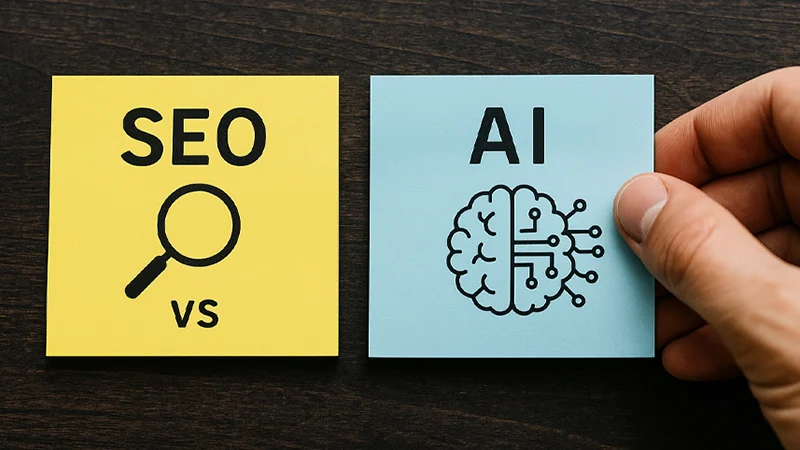
AI SEO vs. Traditional SEO: What’s Different?
| Traditional SEO | AI SEO |
|---|---|
| Optimize to rank in a list of results | Optimize to be cited inside an AI-generated answer |
| Focus on keywords and backlinks | Focus on clarity, structure, and entity authority |
| Success = page 1 ranking | Success = being the source AI recommends |
| One search engine (mostly Google) | Multiple AI platforms (ChatGPT, Gemini, Perplexity, AI Overviews) |
The good news is that these two approaches overlap significantly. Strong traditional SEO — good content, clean site structure, local citations — provides the foundation that AI SEO builds on. You’re not starting from scratch. You’re extending what’s already working.
Why This Matters for Small Businesses in Cave Creek, Carefree, Scottsdale, and Phoenix
Large brands already have name recognition. When someone asks an AI about a well-known national company, there’s enough data in the AI’s training to respond confidently.
Small businesses in Cave Creek, Carefree, Scottsdale, Phoenix, and surrounding communities don’t have that built-in advantage — but they have something better. Hyper-local relevance. AI systems increasingly favor local specificity, and a well-optimized small business website that clearly states its service area can outcompete national brands for local AI-generated answers.
Small businesses with well-structured, helpful content are already appearing in AI-generated answers alongside national brands — not because they have bigger budgets, but because their content is better organized and easier for AI to use.
What You Can Do Right Now
You don’t need to overhaul your entire website to start benefiting from AI SEO. A few targeted improvements go a long way:
- Add or update your FAQ section with questions your actual customers ask — written in plain, conversational language
- Verify your schema markup is in place for your business name, address, phone, services, and hours
- Make sure your name, address, and phone number are identical across your website, Google Business Profile, and every directory listing
- Write content that answers specific questions, not just describes what you do
- Claim and optimize your Bing Webmaster Tools listing — ChatGPT uses Bing’s index, so if you’re not indexed there, ChatGPT may not find you
The Bottom Line
AI SEO isn’t a buzzword or a fad. It’s the natural next step in how search works — and it’s already here. The businesses showing up in AI answers today built their foundation 6 to 12 months ago. The best time to start is now.
At Tech 4 Life, AI SEO is built into every website we design and every SEO engagement we take on. We work with small businesses and nonprofits throughout Cave Creek, Carefree, Scottsdale, Phoenix, and surrounding Arizona communities. If you’d like to know where your business currently stands and what steps would make the biggest difference, we’d love to talk.